Ultrasonic Testing (UT) Overview
超声波检测(UT)概述
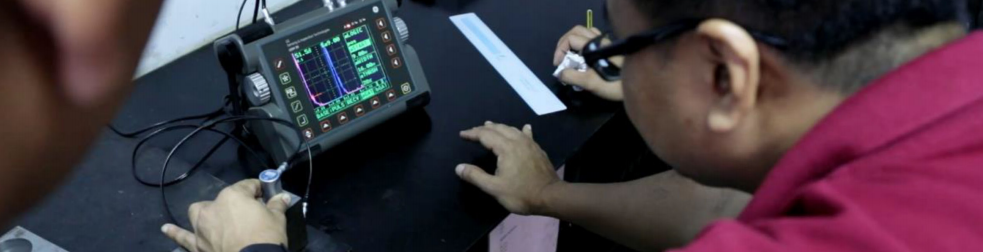
Ultrasonic Testing (UT) is a widely used non-destructive testing (NDT) method that employs highfrequency sound waves to detect internal flaws in materials, measure thickness, and evaluate structural integrity.
超声波检测(UT)是一种广泛应用的无损检测(NDT)方法,它利用高频声波来检测材料内部的缺陷、测量厚度并评估结构完整性。
It is commonly applied in industries such as aerospace, oil and gas, manufacturing, and construction.
它通常应用于航空航天、石油天然气、制造业和建筑业等行业。
Principle of UT(UT原理):
• UT uses sound waves (typically 1-10 MHz) that propagate through a material. When the waves encounter a boundary or defect, part of the wave is reflected back and recorded by the equipment.
超声波检测(UT)利用声波(通常为1-10兆赫兹)在材料中传播。当声波遇到边界或缺陷时,部分波会反射回来并被设备记录下来。
Advantages of UT(UT的优势):
• High sensitivity to small and internal defects.
对微小和内部缺陷具有高灵敏度。
• Accurate thickness measurements.
精确的厚度测量。
• Non-invasive and non-destructive to the material being tested.
对被测试材料无侵入性且无破坏性。
• Portable and suitable for field inspections.
便于携带,适合现场检查。
Limitations of UT(UT的局限性):
• Requires a skilled operator to interpret results.
需要熟练的操作员来解读结果。
• Surface preparation is often necessary for reliable readings.
为了获得可靠的读数,表面处理通常是必要的。
• Less effective for materials with rough or irregular surfaces.
对于表面粗糙或不规则的材料,其效果较差。
Applications of UT
超声波检测的应用
• Weld Inspection: Detecting flaws such as cracks, porosity, and lack of fusion in welded joints.
焊接检查:检测焊接接头中的裂纹、气孔和未熔合等缺陷。
• Thickness Measurement: Measuring the remaining wall thickness of pipes, tanks, or structural components subjected to corrosion or wear.
厚度测量:测量遭受腐蚀或磨损的管道、储罐或结构部件的剩余壁厚。
• Flaw Detection: Identifying inclusions, voids, or other discontinuities in metals, composites, and other materials.
缺陷检测:识别金属、复合材料及其他材料中的夹杂物、空洞或其他不连续缺陷。
• Material Characterization: Evaluating material properties such as grain size and elasticity.
材料表征:评估材料特性,如晶粒尺寸和弹性。
Common UT Techniques
常见的单元测试技术
1. Conventional UT: Uses single or dual-element transducers to detect flaws and measure thickness.
常规超声检测(UT):使用单元素或双元素换能器来检测缺陷和测量厚度。
2. Phased Array Ultrasonic Testing (PAUT): Advanced technique that uses multiple elements to steer, focus, and scan sound beams, providing high-resolution images.
相控阵超声检测(PAUT):一种先进技术,它使用多个元件来控制、聚焦和扫描声束,从而提供高分辨率图像。
3. Time of Flight Diffraction (TOFD): Specialized method for detecting and sizing defects using diffracted waves.
飞行时间衍射(TOFD):一种利用衍射波检测和确定缺陷尺寸的专门方法。
4. Automated UT: Robotic systems for large-scale, repeatable inspections.
自动化UT:用于大规模、可重复检测的机器人系统。
Standards and Certification
标准与认证
UT inspections are governed by international standards such as:
超声波检测(UT)受国际标准的规范,例如:
• ISO 16810: General principles for ultrasonic testing.
ISO 16810:超声波检测的一般原则。
• ASTM E164: Ultrasonic contact examination of welds.
ASTM E164:焊缝的超声接触检测。
• ASME Section V: Ultrasonic testing in pressure vessels and boilers.
ASME第V卷:压力容器和锅炉中的超声波检测。
• AWS D1.1: Ultrasonic inspection for steel welding.
AWS D1.1:钢结构焊接的超声波检测。
Ultrasonic Testing is a versatile and essential tool for ensuring the safety, reliability, and performance of critical components in various industries.
超声波检测是一种多功能且必不可少的工具,用于确保各个行业中关键部件的安全性、可靠性和性能。
 Countries
 Customers
 Schemes
 Team Members

IWCC is an ISO/IEC 17024 accredited certification body which provides auditor certification service to ISO standards.

